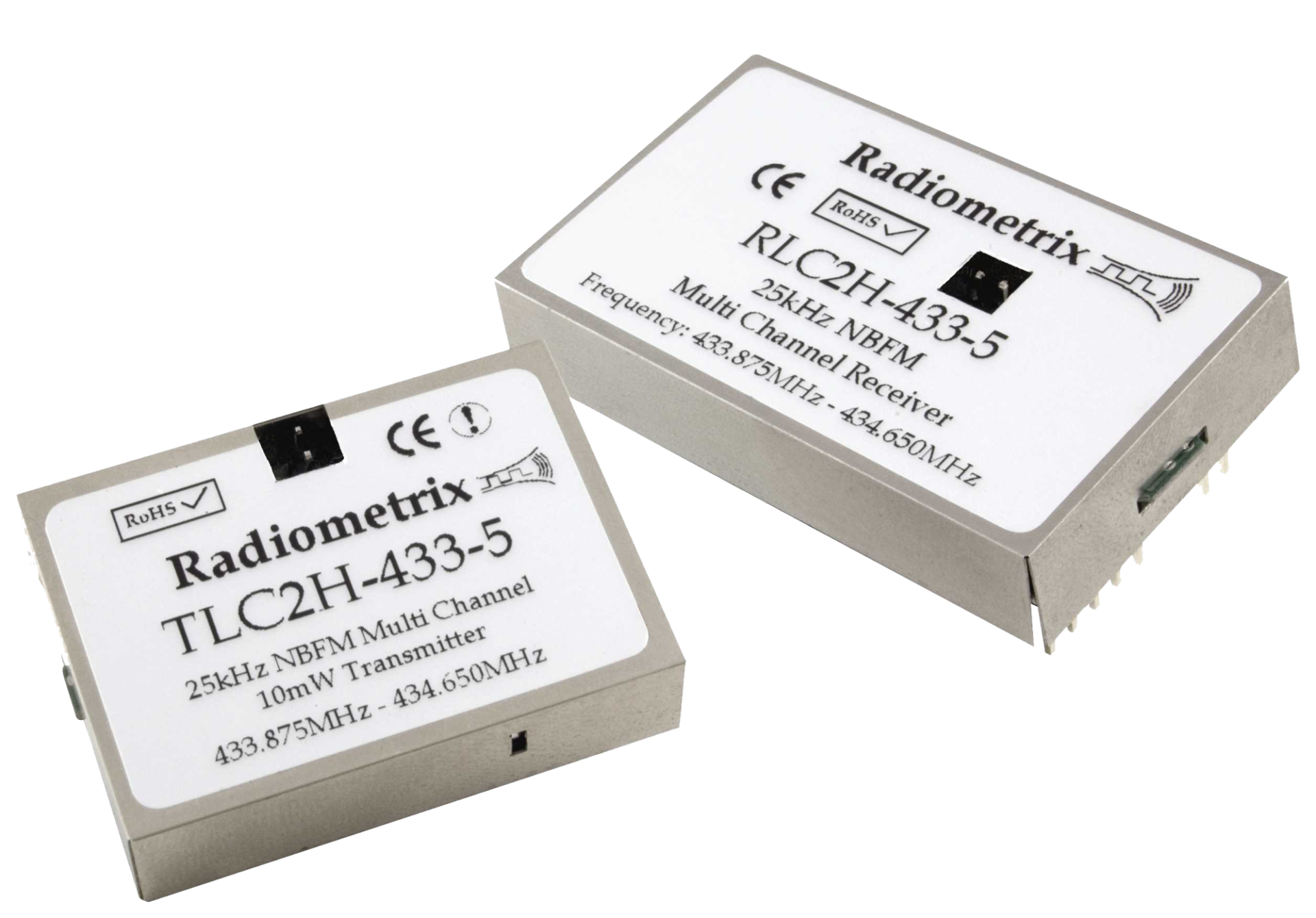
TLC2H/RLC2H
UHF NBFM Low Cost multi channel radio modules
The TLC2H transmitter RLC2H receiver offer a low power, reliable data link in an industry standard pin out and foot print. This makes the TLC2H/RLC2H pair ideally suited to those low power applications where existing wideband modules have insufficient range, or where low cost multi-channel operation is needed without compromising on RF specification or regulatory requirement.
Features
- Conforms to EN 300 220-3 and EN 301 489-3
- High performance double superhet, PLL synthesizer with TCXO
- SAW front end filter
- Data rates up to 5 kbps for standard module
- Usable range over 500m
- Fully screened. Low profile
- Feature-rich interface (RSSI, analogue and digital baseband)
- Re-programmable via RS232 interface
- Low power requirements
Applications
- Handheld terminals
- EPOS equipment, barcode scanners
- Data loggers
- Industrial telemetry and telecommand
- In-building environmental monitoring and control
- High-end security and fire alarms
- DGPS systems
- Vehicle data up/download
- Heavy vehicle/machinery controls
Technical Summary
- Operating frequency: 433.875-434.650MHz
- Any custom frequency on 433 - 435MHz
- 32 channels
- Transmit power: 10dBm (10mW)
- Supply range: 3.1 - 15V Transmit and 3.7 - 15V Receive
- Current consumption: 34mA (transmit), 18mA (receive)
- Data bit rate: 5kbps max. (standard module)
- Receiver sensitivity -120dBm (for 12dB SINAD)
- Serial configuration by inverted RS232 at 3V CMOS level
Evaluation Platform: Narrow Band Evaluation Kit
![]()
Figure 3: TLC2H Footprint (Top view)
Pin Description - TLC2H
|
Pin
|
Name
|
Function
|
|
1
|
Vcc | DC supply (3.1 - 15V at 34mA) |
|
2
|
No pin | Not present |
|
3
|
TXD (MOD NC) | DC coupled input for CMOS logic. Rin = 47kW |
|
4
|
No pin | Not present |
|
5
|
0V | Ground |
| P0/PGM |
parallel channel select pins
|
Channel select LSB bit 0; Serial frequency programming |
| P1 | Channel select bit 1, True logic (0V = low). Weak pullup to 3V | |
| P2 | Channel select bit 2, True logic (0V = low). Weak pullup to 3V | |
| P3 | Channel select MSB bit 3, True logic (0V = low). Weak pullup to 3V | |
| Jumper P4 | Jumper inserted, P4=0 (Channel 00 - Channel 15 at 50kHz step) Jumper clear, P4=1 (Channel 16 - Channel 31 at 50kHs ste |
NOTES:
1. Serial programming is by an inverted, CMOS logic level, 2400 baud RS232 datastream applied to the P0 pin.
2 Parallel channel select is by 4 pin parallel input (LSB selected by a 2mm header, accessed through a hole in the can)
3. Channel select inputs have pullups (10K) to 3V internal rail. Do not exceed 3v logic levels on this port.
4. Transmitter will shutdown if Vcc falls below about 2.9v
5. TXD: logic low < 1.3v, logic high > 1.7v. TXD maximum voltage = 10v
![]()
Figure 5: RLC2H Footprint (Top view)
Pin Description - RLC2H
|
Pin
|
Name
|
Function
|
| 1 | Vcc | DC supply (3.7V to 15V, at 18mA). |
| 2 | RSSI | 0.5V-2.5V DC; 60dB dynamic range; 40kW output impedance |
| 3 | 0V | Ground |
| 4 | RXD | Open collector digital data output, no pullup |
| 5 | AF out | 700mV pk-pk audio. DC coupled, approximately 0.8VDC bias |
| P0/PGM |
parallel channel select pins
|
Channel select LSB bit 0; Serial frequency programming |
| P1 | Channel select bit 1, True logic (0V = low), Weak pullup to 3.5V | |
| P2 | Channel select bit 2, True logic (0V = low), Weak pullup to 3.5V | |
| P3 | Channel select MSB bit 3, True logic (0V = low), Weak pullup to 3.5V | |
| Jumper P4 | Jumper inserted, P4=0 (Channel 00 - Channel 15 at 50kHz step) Jumper clear, P4=1 (Channel 16 - Channel 31 at 50kHz step |
NOTES:
1. Data recovery circuit used for RXD is not a simple 'average and compare' type. It is a peak sampling quasi-DC coupled design, allowing a greater than usual flexibility in data format.
Maximum time between data transitions: 250ms
2. Serial programming is by a 2400 baud inverted 'RS232' (3V CMOS levels) datastream applied to the P0 pin. If connection to a true RS232 port is desired, then a suitable inverting level shifter / buffer (MAX232 or NPN switch transistor) is needed.
3. Parallel channel select is by a 4 pin parallel input (MSB selected by a 2mm header, accessed through a hole in the can). 3V CMOS levels should be used.
4. As supplied the frequency table is thus:
ch 0-15 433.875 - 434.625 MHz (50KHz steps)
ch 16-31 433.9 - 434.65 MHz (50KHz steps)
Serial interface commands
TLC2H/RLC2H frequency/channel can be serially configured using HyperTerminal or any other terminal program configured with following setup:
2400 baud RS232, 8 bit data, no parity, 1 start bit, 1 or 2 stop bits. No flow control
Serial data is sent to the unit on one of the parallel channel select pins (P0). It is very important that the unit does not 'decode' switch bounce in ordinary operation as a command string, or spurious re-writing of the e2prom will result. For this reason the user must send the 16 character string ENABLESERIALMODE to fully enable the serial command mode before sending any of the command strings listed below. Command mode is disabled on power down, or on reception of a # character.
| GOCHAN aa | Serial select of channel aa (0 to 31) |
| LOAD aa nnnnn | Set value of N register for channel aa, where aa is Channels 0 to 31 |
| RVALUE rrrr | Set value for R register |
| SETPAR | Channel selected by 5 bit parallel inputs (4pins + jumper) |
| SETSER | Channel selected by most recent 'GOCHAN' operation |
| SINGLE nnnnn | Set value of N for single channel operation. N value NOT stored in EEPROM |
| <cr> | Process entry |
| / | Clear all buffers |
| # | Disable command mo |
aa = a two digit channel number from 00 to 31
nnnnn = a synthesizer N register value, (up to 65535)
rrrr = the synthesizer R register value, (up to 16383)

![]() |
So R = 520 |

Notes:
A pause of at least 25ms must be allowed between command strings (EEPROM programming time).
SINGLE mode does not store the N value in EEPROM. Therefore the unit is inoperative after a power down until either another valid SINGLE command is received, or mode is changed by a GOCHAN, SETPAR or SETSER command. SINGLE mode is intended for frequency agile applications.
TLC2H, RLC2H channels are spaced at 50kHz interval into two frequency groups. 50kHz spacing between sequential channels minimises adjacent channel interference. S4 jumper determines which frequency group is selected.
|
hannel 0-15
Jumper (P4) Inserted |
Frequency (MHz)
|
Channel 16-31
Jumper (P4) clear |
Frequency (MHz)
|
|
0
|
433.875 | ||
|
16
|
433.900 | ||
|
1
|
433.925 | ||
|
17
|
433.950 | ||
|
2
|
433.975 | ||
|
18
|
434.000 | ||
|
3
|
434.025 | ||
|
19
|
434.050 | ||
|
4
|
434.075 | ||
|
20
|
434.100 | ||
|
5
|
434.125 | ||
|
21
|
434.150 | ||
|
6
|
434.175 | ||
|
22
|
434.200 | ||
|
7
|
434.225 | ||
|
23
|
434.250 | ||
|
8
|
434.275 | ||
|
24
|
434.300 | ||
|
9
|
434.325 | ||
|
25
|
434.350 | ||
|
10
|
434.375 | ||
|
26
|
434.400 | ||
|
11
|
434.425 | ||
|
27
|
434.450 | ||
|
12
|
434.475 | ||
|
28
|
434.500 | ||
|
13
|
434.525 | ||
|
29
|
434.550 | ||
|
14
|
434.575 | ||
|
30
|
434.600 | ||
|
15
|
434.625 | ||
|
31
|
434.650 |
Condensed specifications
| Frequency | 433.875 - 434.675MHz (32 channels) Custom variants on 433-435MHz |
|
Frequency stability |
+/- 1.5kHz |
|
Channel spacing
|
25kHz (12.5kHz by special order) |
|
Number of channels
|
32 channels controlled via RS232 interface |
| Operating temperature | -10 to +60 °C (Storage -30 to +70 °C) |
| Spurious radiations | Compliant with ETSI EN 300 220-3 and EN 301 489-3 |
| Intended approval | ETSI EN 300 220-3 (radio) and EN 301 489-3 (EMC) |
| Transmitter | |
| Supply | |
| Voltage | 3.1V - 15V |
| Current | 34mA nominal |
| Output power | 10mW +/- 1dB (1mW or 5mW by special order) |
| TX on switching time | 50ms from power up |
| Peak FM deviation | +/-3kHz |
| Modulation type | FSK (F3D) |
| TX modulation bandwidth | DC - 5kHz (3V CMOS compatible) |
| Adjacent channel TX power | -37dBm |
| TX spurious | <-45dBm (<-60dBm in standby) |
| Inputs | analogue, data (CMOS/TTL compatible) |
| Size | 37x27x8mm |
| Interface user | 3pin 0.2" pitch molex |
| Channel | 4pin 0.1" pitch molex |
| RF | 2pin 3mm pitch |
| Recommended PCB hole size | 1.2mm |
| Receiver | |
| Sensitivity | -120dBm for 12 dB SINAD |
| image/spurii | -60dB |
| blocking | -85dB |
| LO re-radiation | <-60dBm |
| adj. Channel | <-60dB |
| Supply | |
| Voltage | 3.7V - 15V |
| Current | 18mA |
| outputs | RSSI, audio, digital data (quasi DC data recovery circuit) |
| Size | 50 x 30 x 10 mm |
| Interface user | 5pin 0.1" pitch molex |
| Channel | 4pin 0.1" pitch molex |
| RF | 2pin 0.1" pitch molex |
| Recommended PCB hole size | 1.2mm |
| Power on to valid AF | 28ms |
| Power on to stable RXD (50:50 mark / space) | 50m |
Notes: When RX is on and a transmitter keys up, again a 50ms period is required to stabilise data output mark/space. i.e. allow at least 50ms of preamble
RX Received Signal Strength Indicator (RSSI)
The RLC2H has wide range RSSI which measures the strength of an incoming signal over a range of 60dB or more. This allows assessment of link quality and available margin and is useful when performing range tests.
The output on pin 2 of the module has a standing DC bias of up to 0.4V with no signal, rising to 2.5V at maximum indication (RF input levels of -40dBm and above). DVmin-max is typically 2V and is largely independent of standing bias variations. Output impedance is 40kW. Pin 2 can drive a 100mA meter directly, for simple monitoring.
Typical RSSI characteristic is as shown below:
![]()
Figure 6: RSSI level with respect to received RF level at RLC2H antenna pin
Antenna requirements
Three types of integral antenna are recommended and approved for use with the module:
A) Whip: This is a wire, rod, PCB track or combination connected directly to RF pin of the module. Optimum total length is 16cm (1/4 wave @ 433MHz). Keep the open circuit (hot) end well away from metal components to prevent serious de-tuning. Whips are ground plane sensitive and will benefit from internal 1/4 wave earthed radial(s) if the product is small and plastic cased
B) Helical: Wire coil, connected directly to RF pin, open circuit at other end. This antenna is very efficient given it's small size (20mm x 4mm dia.). The helical is a high Q antenna, trim the wire length or expand the coil for optimum results. The helical de-tunes badly with proximity to other conductive objects.
C) Loop: A loop of PCB track tuned by a fixed or variable capacitor to ground at the 'hot' end and fed from RF pin at a point 20% from the ground end. Loops have high immunity to proximity de-tuning.
|
A
|
B
|
C
|
|
|
Whip
|
Helical
|
Loop
|
|
| Ultimate performance |
***
|
**
|
*
|
| Easy of design set-up |
***
|
**
|
*
|
| Size |
*
|
***
|
**
|
| Immunity proximity effects |
*
|
**
|
***
|
| Range open ground to similar antenna |
500
|
200
|
1
|
The antenna choice and position directly controls the system range. Keep it clear of other metal in the system, particularly the 'hot' end. The best position by far, is sticking out the top of the product. This is often not desirable for practical/ergonomic reasons thus a compromise may need to be reached. If an internal antenna must be used, try to keep it away from other metal components, particularly large ones like transformers, batteries and PCB tracks/earth plane. The space around the antenna is as important as the antenna itself.
Ordering Information
Part No. Description Frequency band (MHz)
TLC2H-433-5 UHF multi channel narrow band FM transmitter 433.875-434.650MHz
RLC2H-433-5 UHF multi channel narrow band FM receiver 433.875-434.650MHz
Limitation of liability
The information furnished by Radiometrix Ltd is believed to be accurate and reliable. Radiometrix Ltd reserves the right to make changes or improvements in the design, specification or manufacture of its subassembly products without notice. Radiometrix Ltd does not assume any liability arising from the application or use of any product or circuit described herein, nor for any infringements of patents or other rights of third parties which may result from the use of its products. This data sheet neither states nor implies warranty of any kind, including fitness for any particular application. These radio devices may be subject to radio interference and may not function as intended if interference is present. We do NOT recommend their use for life critical applications.
The Intrastat commodity code for all our modules is: 8542 6000.
R&TTE Directive
After 7 April 2001 the manufacturer can only place finished product on the market under the provisions of the R&TTE Directive. Equipment within the scope of the R&TTE Directive may demonstrate compliance to the essential requirements specified in Article 3 of the Directive, as appropriate to the particular equipment.
Further details are available on The Office of Communications (Ofcom) web site:
Licensing policy manual