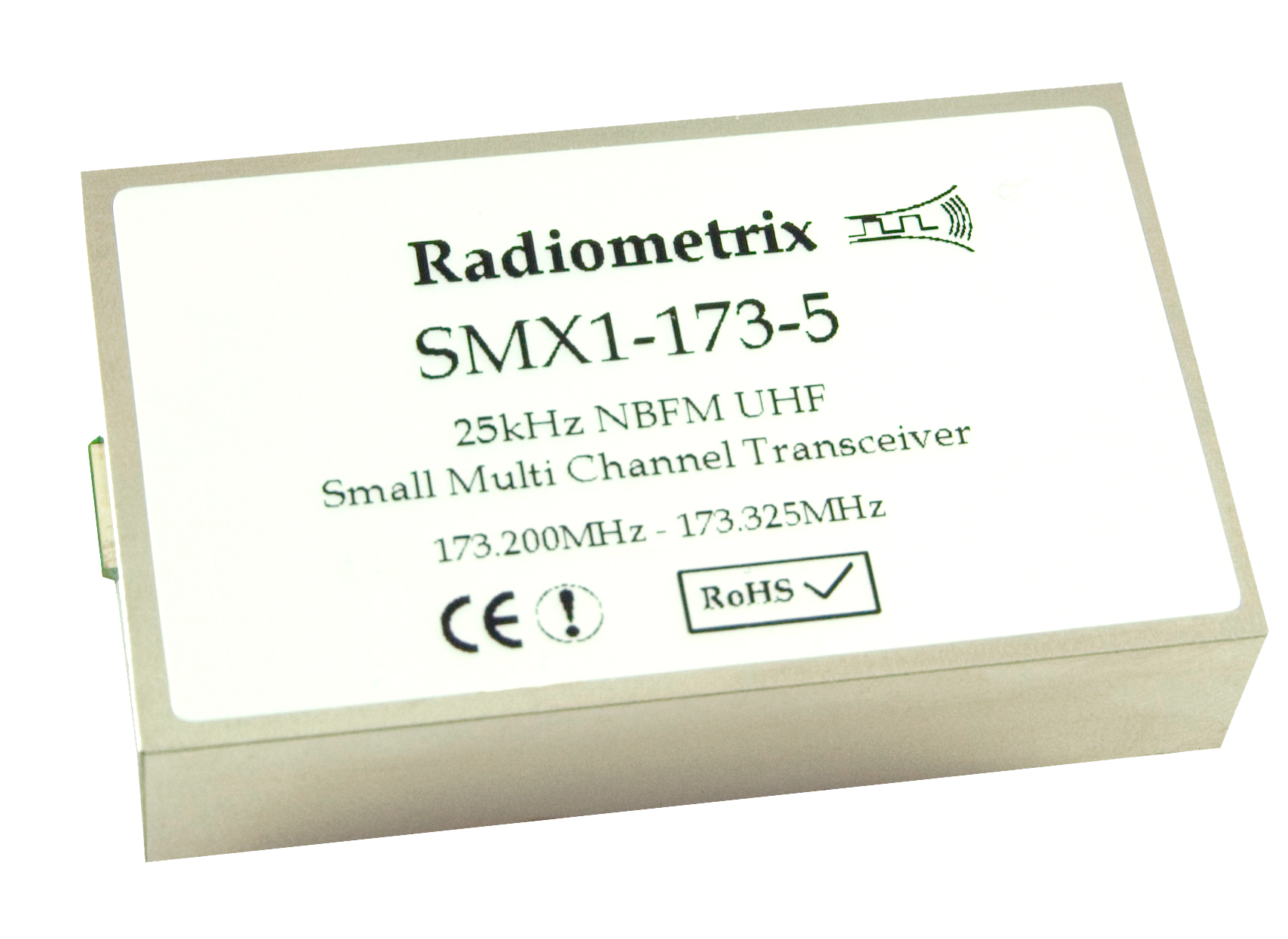
SMX1
VHF Narrow Band FM Multi channel Transceiver
SMX1 is small multi-channel VHF transceiver operating on 173.200MHz-173.325MHz band. SMX1 offers a fast-route to custom frequency on any VHF band from 130MHz to 180MHz with 25kHz channel spacing.
Features
- Conforms to ETSI EN 300 220-3 and EN 301 489-3
- High performance double superhet, 128 channel PLL synthesizer
- Data rates up to 5 kbps for standard module
- Usable range over 1km
- Fully screened
- Feature-rich interface (RSSI, analogue and digital baseband)
- Incorporates a 1200baud dumb modem
- Re-programmable via RS232 interface
- Low power requirements
Applications
- Handheld terminals
- Heavy vehicle/machine remote controls
- EPOS equipment, barcode scanners
- Data loggers
- Industrial telemetry and telecommand
- In-building environmental monitoring and control
- High-end security and fire alarms
- Vehicle data up/download
Technical Summary
- Operating frequency: 173.200 - 173.325MHz
- Custom variants from 130 - 180MHz on any 1MHz band
- 128 channels controlled via RS232 interface
- Transmit power: +10dBm (10mW) nominal. Adjustable 1 - 50mW
- Supply range: 4.2V - 16V
- Current consumption: 40mA (10mW) - 65mA (50mW) transmit, 20mA receive
- Data bit rate: 5kbps max. (standard module)
- Receiver sensitivity: -120dBm (for 12 dB SINAD)
- Size: 53 x 32 x 12mm
Evaluation Platform: Narrow Band Evaluation Kit
Figure 3: SMX1 footprint (Top)
Pin Description
| Pin | Name | Function |
| 1a | RSSI | DC level between 0.5V and 2.5V. 60dB dynamic range |
| 2a | Vcc | DC supply input. (4.2 - 16V at 40mA nominal) |
| 3a | TXD | DC copled input for TTL/COMS logic |
| 4a | AF out | 500mVp-p audio. DC coupled, approx. 0.8V bias |
| 5a | RXD | Open collector output of data slicer. Need external pull-up |
| 6a | TXE | Transmit enable. Low = RX. High = TX (10kW pulldown) |
| 7a | PGM | Serial programming / control input (true RS232) |
| 8a | 0V | Ground |
| 1b | 0V | Ground |
| 2b | S0 | Parallel channel select LSB |
| 3b | S1 | Parallel channel select |
| 4b | S2 | Parallel channel select MSB |
Pin description of SMX1 with Modem mode selected
The 'modem' mentioned is a 1200 baud RS232 semi-intelligent unit (Transmit keyed when valid serial data is present, so no separate TX control needed. Coding in the datastream also permits the receiver to ignore noise and only output valid serial data) This is a half duplex unit, so collisions between transmitted and received packets must be dealt with by the user (if transmit data is sent to the unit then a transmit burst commences immediately and the contents of the receive data buffer is lost)
|
Pin
|
Name
|
Function
|
| 1a | RSSI | DC level between 0.5V and 2.5V. 60dB dynamic range |
| 2a | Vcc | DC supply input. (4.2 - 16V at 40mA nom.) |
| 3a | NC | Leave unconnected |
| 4a | NC | Leave unconnected |
| 5a | RXD | Open collector RS232 compatible data output |
| 6a | TXD | RS232 data input |
| 7a | PGM | Serial programming/control input (true RS232) |
| 8a | 0V | Ground |
| 1b | 0V | Ground |
| 2b | S0 | Parallel channel select LSB |
| 3b | S1 | Parallel channel select |
| 4b | S2 | Parallel channel select MS |
Notes:
1. No inversion occurs between TXD and RXD. However AF out is inverted relative to TXD.
2. Parallel channel selects are active LOW and have internal pullups to 4V
3. There are no pullups on the open collector outputs.
4. The software incorporates a 1200 baud modem, compatible with that implemented in other Radiometrix narrowband units ( i1200 tones and format ). Modem operation is selected by the SETMOD command. TXE pin (6a) becomes an RS232 input, and RS232 compatible data is output on the RXD pin (5a). If true +/- levels are desired then an inverter and a MAX232 should be used on data out.
5. RS232 input pins (7a and 6a) tolerate true +/- levels. No buffering is required.
6. If analogue transmit modulation is needed, then connect a series 1mF cap + 500kW trimmer in the 'baseband in' circuit. Adjust trimmer for 90% of peak deviation (+/- 2.7KHz) at mean input level.
7. If parallel channel select is not wanted, the 4 pin connector 'b' can be removed
8. For UK version the following channel assignment is supplied:
Channel Frequency (MHz)
0 173.250
1 173.275
2 173.300
3 173.325
4 -7 173.225 (only used for alarm applications)
8 -127 173.325
SMX1 serial interface commands
2400 baud at RS232 level. 8 bit data, no parity, 1 start bit, 1 or 2 stop bits, No flow control.
Transmit (pin 3 on DB9) and Signal Ground (pin 5 on DB9) should be connected to PGM and and 0V respectively.
| SINGLE nnnnn | set value of N for single channel operation (value not stored on EEPROM) |
| GOCHAN xx | serial select of channel xx (0 to 127) |
| LOADMX xx | set highest permitted (serial selected) channel xx (others default to ch0) |
| LOAD aa nnnnn | set value of N for channel aa (channels 0 to 15) |
| LOADTB nnnnn | set value of N for channel 16 (channels 17 to 127 then in sequence) |
| RVALUE rrrr | enter value for R register |
| SETPAR | channel selected by 3 bit parallel input (0 to 7). Also Disable modem |
| SETSER | channel selected by most recent 'gochan' operation |
| SETMOD | enable internal modem. Frequency selected by most recent 'gochan' or 'single' |
| <cr> | process entry |
| / | clear all buffer |
xx = a channel number from 00 to 127
aa = a two digit channel number from 00 to 15
nnnnn = a synthesizer N register value, (up to 65535)
rrrr = the synthesizer R register value, (up to 16383)

![]()
![]() |
, So R = 520 |
Notes:
1. A pause of at least 50ms must be allowed between command strings (EEPROM programming time).
SINGLE mode does not store the N value in EEPROM. Therefore the unit is inoperative after a power down until either another valid SINGLE command is received, or mode is changed by a GOCHAN, SETPAR or SETSER command. SINGLE mode is intended for frequency agile applications.
2. /SETPAR command should be issued at the end of channel programming to put the module back into parallel frequency select mode.
Condensed specifications
| Frequency | Any 1MHz band from 130 -180MHz (173.200 - 173.325 MHz UK standard) |
|
Frequency stability |
+/- 2kHz |
|
Channel spacing
|
25kHz (12.5kHz by special order) |
|
Number of channels
|
128 channels controlled via RS232 interface; 8 channels selected via 3 frequency select pins |
| In UK band, only 173.250, 173.275, 173.300 and 173.325 MHz are used as standard | |
| Supply voltage | 4.2V - 16V |
| Current | 40mA (10mW); 65mA (50mW) transmit |
| 20mA receive (or modem 'idle') | |
| Operating temperature | -10 to +60 °C (Storage -30 to +70 °C) |
| Size | 53 x 32 x 12mm |
| Spurious radiations | Compliant with ETSI EN 300 220-3 and EN 300 686 |
| Interface user | 8pin 0.1" pitch molex |
|
Power |
4pin 0.1" pitch molex |
|
RF |
3pin 0.1" pitch molex |
| Recommended PCB hole size | 1.2mm |
| Intended approval | ETSI radio standard EN 300 220-3 and EMC standard EN 301 489-3 |
| Transmitter | |
| Output power |
UK standard +10dBm(10mW) ± 1dB (factory adjustable: 1 - 50mW) |
| TX on switching time | 50 ms |
| Modulation type | FM, FSK (F1D, F3D) |
| TX modulation bandwidth | DC - 3kHz |
| Deviation | ±2.6kHz to ±3kHz |
| Adjacent channel TX power | -37dBm |
| Inputs | data (CMOS/TTL compatible) |
| Receiver | |
| Sensitivity | -112dBm for 1 part per 1000 BER |
| -120dBm for 12 dB SINAD | |
| image / spurious | -65dB |
| blocking | -85dB |
| adjacent Channel | <-65dB (Tested per. ETSI EN 301 489-3) |
| outputs | RSSI, audio, data |
| Power on to valid audio | 28ms |
| Power on to stable data out | 50ms (50:50 mark / space |
Notes:
1. The data slicer cannot be depended upon for data waveform frequencies below 250Hz
2. When RX is on and a transmitter keys up, again a 50ms period is required to stabilise data output mark/space. i.e. allow at least 50ms of preamble
Application circuit
![]()
Figure 4: SMX1 interfaced to host microcontroller and serial port for configuration
![]()
Figure 5: SMX1 interfaced to PC serial port (0V / 5V RS232 level)
![]()
Figure 6: SMX1 interfaced to serial port (+10V / -10V RS232 level)
Limitation of liability
The information furnished by Radiometrix Ltd is believed to be accurate and reliable. Radiometrix Ltd reserves the right to make changes or improvements in the design, specification or manufacture of its subassembly products without notice. Radiometrix Ltd does not assume any liability arising from the application or use of any product or circuit described herein, nor for any infringements of patents or other rights of third parties which may result from the use of its products. This data sheet neither states nor implies warranty of any kind, including fitness for any particular application. These radio devices may be subject to radio interference and may not function as intended if interference is present. We do NOT recommend their use for life critical applications.
The Intrastat commodity code for all our modules is: 8542 6000.
R&TTE Directive
After 7 April 2001 the manufacturer can only place finished product on the market under the provisions of the R&TTE Directive. Equipment within the scope of the R&TTE Directive may demonstrate compliance to the essential requirements specified in Article 3 of the Directive, as appropriate to the particular equipment.
Further details are available on The Office of Communications (Ofcom) web site:
Licensing policy manual